
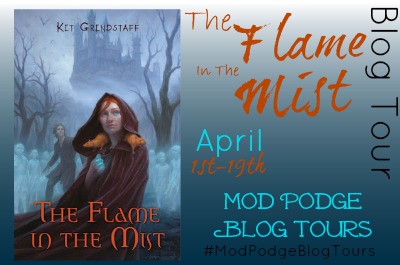
Watercolor Moods welcomes another wonderful author, Kit Grindstaff, today for The Flame in the Mist Blog Tour (courtesy of The Mod Podge Bookshelf)! I've been wanting to ease out into middle grades recently, seeing as they did so much to shape me as a writer and reader when I was that age, and I'm so glad to start things off with Kit's guest post.
Talking about middle-grade Kaye, I can definitely say that feisty heroines were - and still are - something that I think should be available to every girl reader. Kit was a great sport and wrote a guest post that made me want to push everything to the side and bang my hand on the table Thor-style for The Flame in the Mist.
RIGHT NOW.
(Okay. You can feel free to just skip to the blog post now.)
As a reader of fantasy, I love a strong character—someone I can root for while getting exasperated by the flaws which keep tripping them up. Someone who might possess magical powers, yet is still human and fallible. Examples exist all over middle grade and YA lit, whether it’s Harry and his growing impatience as he edges into his edgy teens, Renee and her headstrong will in Alex Lidell’s recent debut The Cadet of Tildor, Lyra Belacqua from Philip Pullman’s His Dark Materials trilogy, who has an amazing propensity for telling elaborate lies—the flaw that is her gift—or light-fingered Conn in Sarah Prineas’s The Magic Thief.
So if they’re so human and fallible, what makes a fictional hero or heroine? Are they born to greatness, or do circumstances thrust it upon them? That question echoes the age-old Nature vs Nurture debate of Real Live Humans. The word “nurture” can be a bit misleading, since to me it implies caring, and it’s often lack of it that influences someone’s development. So really, “circumstances” is a better word. An analogy I like is that a child is like an undeveloped photograph; the potential is already fully formed (nature) but how it forms, or even how much, depends on what happens (nurture). Neither one nor the other accounts for it all; the developed picture is always an interplay between the two.
In The Flame in the Mist, it’s clear from chapter 1 that soon-to-be 13-year-old Jemma despises the Mist surrounding Agromond Castle. She fantasizes a world beyond it, where sunshine reigns—a world which has been described to her by her erstwhile nursemaid and confidante, Marsh. Jemma is a dreamer. Her evil captor Nocturna even refers to her as having been “dreamy-headed” all her life, leading Nocturna to doubt that Jemma has the evil in her bones that would make her choose to come over to the dark side—in other words, her nature decrees otherwise. In the eyes of Jemma’s arch-nemesis, Shade, this dreaminess also makes Jemma weak, and worthy of scorn.
“Dreamy-headed” is hardly the stuff of a heroine, though…unless, like in Jemma’s case, it’s paralleled by her having prophetic nightmares. She’s more than just a starry-eyed girl staring out of windows and longing for something different: her blood is the blood of Visionaries, and provides her with an innate sense that Something is Wrong at Agromond Castle. She knows she is essentially different from the family she believes to be hers…and for good reason. She is. Nature rules—so strongly, in fact, that she’s resisted all attempts by the Agromonds to win her over to the Dark Side.
But at the beginning, her nature is not very developed. Without a catalyst, she might stay at the castle and never be heard of again. What better as an agent of growth and change than a little life-or-death challenge thrown at a hero or heroine? When Jemma discovers the very real and great danger she’s in, she has to pull courage from her core like a rabbit from a hat—and fast.
“Throw adversity in your protagonist’s path” is something that any aspiring writer hears along the way. And just like in real life, adversity is what forces growth in fiction. Keep up tension by hurling one monster after another (literal or metaphorical) at your main character, and they can’t help but change. Bottom line, when it is life or death, if they don’t meet the challenge, they’re a gonner. Jemma faces jaws of…well, I won’t say what; but she keeps having to call upon something she’s already learned and assimilate it by using it, and comes out the other side that much stronger.
The Inner Hero’s growth can happen in subtler ways too. For example, when Jemma does her first real healing, it requires a different kind of courage and conviction from her. Her responses to outside forces, called up from the depths of her, in turn strengthen who she is as bit by bit she steps into the shoes of the Heroine. They were always there, waiting for her, but she has to take the steps, and then fill those shoes.
Not that those changes come easily, or without resistance, or without a price. There’s always that moment where a character can’t or won’t take on the mantle of their mission. Adding to that, there’s those delicious human flaws which can—and should—trip up the worthiest hero or heroine over and over again. Those flaws are a character’s default, and often is a part of their gift, as with Lyra Belacqua, whose lying gets her out of tough situation, or Conn, whose thievery starts him on his path of Destiny. Jemma is headstrong and stubborn, which are gifts that often help her survive. But part of being human means learning to discriminate: when does such a characteristic serve our heroine well, and when not? Often Jemma’s stubbornness means she doesn’t heed advice, which lands her in hot water.
People have asked how much Jemma is like me. In some ways, her experiences are metaphorical versions of my own; inner demons translated into outer ones on the page. But she’s feistier and braver than I ever was. At 13, there were many geese I wouldn’t have said “boo” to, and Jemma says “boo” to far worse than geese. And she has powers I’ll never possess. Although who knows, if I’d been trapped in a damp castle in mortal danger, maybe I could have pulled a few magical rabbits out of my hat, too. Somehow, though, I don’t think it’s in my nature.
 Kit Grindstaff
was born near London, and grew up in the rolling countryside of
England. After a brush with pop stardom (under her maiden name, Hain)
she moved to New York and embarked on her career as a pop song writer. Kit now lives with her husband in the rolling countryside of Pennsylvania. She is a member of the SCBWI. The Flame In The Mist is her first novel.
Kit Grindstaff
was born near London, and grew up in the rolling countryside of
England. After a brush with pop stardom (under her maiden name, Hain)
she moved to New York and embarked on her career as a pop song writer. Kit now lives with her husband in the rolling countryside of Pennsylvania. She is a member of the SCBWI. The Flame In The Mist is her first novel.
Thanks so much, Kit! You rock! And thanks to everyone following the blog tour! Now, I know that a lot of you are probably going, "Awesome post, but isn't there some sort of giveaway?"
Ask and you shall receive.
Just fill out the handy-dandy Rafflecopter form down there to win this awesome swag!

Thanks once again to Gabrielle Carolina for pulling together such an awesome blog tour! Tomorrow: An interview with Kit with the marvelous Hafsah of IceyBooks! And remember that Gabrielle will be having a Twitter chat on the 19th!

If I were you, I wouldn't want the Agromonds around. Just saying.


